Vinaora Nivo SliderVinaora Nivo SliderVinaora Nivo SliderVinaora Nivo SliderVinaora Nivo Slider

Previous Next
Charitable event and artistic programme dedicated to Evagoras Pallikarides

Dear parents,

We would like to inform you that our school is beginning a charitable drive of assistance for fellow Greeks and Paphians that have fallen victim of the economic crisis. Our charitable drive will include the donation of clothing and dry food products.

The campaign, “I love Greece…but I also love Paphos,” commencing on March 14th and ending on March 21st with a full day of activities on our school grounds, is dedicated to the young Paphian student and poet Evagoras Pallikarides.

Read more
Tuition Fees

Please download the specific fees relevant to each department/school. This section is split up between our two campuses Limassol and Paphos.

Limassol Campus

eyfeeprfee

secfeesgreekfee

Paphos Campus

Read more
Introduction

American Academy has been improving the educational performances of its students and guaranteeing an astonishing success in the teaching-learning process in a number of ways that are specifically fit to match the needs of the parents, staff, students, and whoever else is involved in learning environment of its schools.


Our website and design team are trying their best to provide the direct information you require to paint the actual image of the school however to get a complete picture we encourage you to meet our warm and hardworking staff for yourself.


Applicants are more than welcomed to spend a day with us and meet some of the current students and experienced staff who make American Academy the spectacular place that it is.


On behalf of the entire admissions team, thank you for your interest in American Academy, and we look forward to meeting you.


Best regards,

Admission office team

Read more
General Admissions Requirements

Pre-enrollment Requirements

In order for a new student to be considered for admission to the American Academy the following must be on file at the school

  • Completed application form
  • Student's academic report card for the previous years
  • Copies of a valid resident permit (if applicable)
  • Copy of the passport
  • Original birth certificate
  • Copy of Father’s/Mother’s/ Guardian’s Passport/ ID Cards
  • Attested copies of G.C.S.E./G.C.E./ IELTS/ TOEFL (Secondary school only)
  • Health Certificate (Pre-kindergarten early years and Reception)

Additional Requirements for students outside the country

The report card has to be certified by the ministry of education and the ministry of foreign affairs in the country of origins.

Enrollment Details

Enrollment opens during the month of May and continues until all available spots are filled in a given class. Priority in enrollment is as follows:

  • Students already enrolled in school
  • Siblings of students already enrolled at American Academy
  • All others

Admission Process

  1. Entrance exam: all prospect students must take an entrance exam (English and Mathematics)
  2. Admission package submission: Parents must complete the admission form and submit the necessary documents
  3. Registration: Pay a non- refundable sum of €100 per child to each reservation. (This amount includes insurance)
  4. Deposit: Pay a non-refundable of 20% of the tuition fees according to the students allocated class (This amount is part of the full tuition fees)
  5. Parents and Children Association (PTA) membership fee. Collected annually in the sum of €10
Read more
Application Form

Download the application form to fill in from here. (Right click, Save Target As...)


Online Applications will be in effect soon.

Read more
Secondary School

Our school follows a modified English National Curriculum designed to provide a well-balanced education, which caters to students' needs, and encourages the development of their full potential as citizens of tomorrow. We offer:

  • a wide choice of subjects at GCSE, IGCSE, AS and A-Level
  • fully equipped Biology, Chemistry, Physics, D&T and ICT laboratories
  • Art, Music, Drama rooms and a fully functioning Library
  • American Academy School Leaving Certificate (Apolytirion) approved by the Ministry of Education and recognised by universities worldwide
  • entry to the best universities of the UK, USA, Australia, Canada, as well as those of Cyprus, Greece and Europe
  • excellent pastoral care, careers guidance and counselling
  • a wide range of extra curricular activities including the prestigious Duke of Edinburgh International Award

Curriculum Structure

Age Stage Class External Examinations
11-12 Key Stage 3 Class 1  
12-13 Key Stage 3 Class 2  
13-14 Key Stage 3 Class 3 GCSE/IGCSE in Greek/Russian
15-16 Key Stage 4 Class 4 GCSE/IGCSE AS-Level in Greek/Russian/French
16-17 Key Stage 4 Class 5 GCSE/IGCSE A-Level in Greek/Russian/French
17-18 Key Stage 5 Class 6 AS-Level
18-19 Key Stage 5 Class 7 A-Level

Key Stage 3

This stage comprises of the first three years of secondary schooling normally known as Class 1, Class 2 and Class 3 (in the UK referred to as Year 7, Year 8 and Year 9), when pupils are aged between 11 and 14. During this stage the core curriculum is compulsory for all students and includes the following subjects: Art, Drama, English Language, English Literature, French, Geography, Greek/Special Greek, History, Information Communication Technology, Mathematics, Music, Physical Education, Religious Education, Science, Personal and Social Education.

In Class 3, when students choose their subject options for the following year, every effort is made to offer as broad a range of subjects as possible from the Key Stage 3 and Key Stage 4 curriculum, and students are guided by the school counsellor and careers advisor to make informed and balanced choices.

Key Stage 4

These two years (Class 4, Class 5) offer a program of courses that prepare students for the International GCSE and GCSE examinations. Every student must take English Language and Mathematics as well as a language option. A further four optional subjects are chosen from a broad list which currently includes Art, Accounting, Biology, Chemistry, Drama, Economics, English Literature, French, ICT, Geography, German, Greek*/Special Greek, History, Music, Physical Education, Physics, Russian.

The American Academy is one of the few schools that enables students to complete their AS-Level in Greek in Class 4 and A-Level in Class 5, two whole years ahead of time. Therefore providing students the opportunity to graduate with up to 5 A-Level qualifications.

Key Stage 5

At this stage (Class 6, Class 7) each student constructs an individual programme track of AS/A2 level courses which ultimately lead to General Certificate of Education Advanced Level Qualifications (known as GCE A-level) and Apolyterion subjects from a very wide range of options.

Students may choose one of three programme tracks to study:

1. A-Level Track

Students study four AS subjects in Class 6 and carry on with four of them at A2 level in Class 7. Successful completion of this programme track leads to four A-level qualifications and the School Leaving Certificate- Apolyterion.

2. Apolyterion Track:

Students choose non externally examined subjects for two years leading to successful completion of the School Leaving Certificate- Apolyterion.

3. Combined track:

Students have the opportunity to study a combined course of AS, A-level, and Apolyterion subjects.

The school operates a very flexible options system and makes a considerable effort to accommodate the combinations of subjects chosen by students.

English, Personal and Social Education, and Physical Education are compulsory subjects.

Optional subjects include:

A-Level subjects: Art, Accounting, Biology, Business Studies, Chemistry, Drama, Economics, English Literature, French, History, Information Communication Technology, Mathematics, Music, Physical Education, Physics.

Apolyterion subjects: Business & Marketing, General Science, Politics, Critical Thinking & Ethics.

Read more
Primary School

At The American Academy Primary School there exists a welcoming family atmosphere of warmth, security, trust and friendliness. Our aim is to bring out the best in every child and we are committed to nurturing positive attitudes and respect.

The time your child will spend in primary education is exciting, challenging, rewarding and joyous. It is, after all, the most important period of your child's life as well as in the life of your family. We want our children to enjoy school, to be happy, to have self-esteem and to develop confidence in themselves and their abilities. We acknowledge children as individuals with differing strengths and needs and we support them to achieve their full potential, guiding them to give of their best by appreciating what they do well and helping them to see how they could do better.

Children's educational outcomes are maximised wherever parents are actively involved in the school and so we strive to forge solid partnerships between children, teachers and parents, enabling them to actively participate together for a positive educational outcome. We work to give children a thorough grounding in basic skills; to develop a lively interest and curiosity about the world in which they live and to develop a love of learning that will stay with them throughout their life.

Curriculum Structure

Age Stage Class
5+ Key Stage 1 Year 1
6+ Key Stage 1 Year 2
7+ Key Stage 2 Year 3
8+ Key Stage 2 Year 4
9+ Key Stage 2 Year 5
10+ Key Stage 2 Year 6

Key Stage 1

This stage comprises of the first two years of Primary School.  Children between the ages of 5 and 7 will study the Core Curriculum subjects which are: English, Mathematics, Science and Greek for Natives.

Other Foundation Curricular subjects include: Special Greek for non natives, Geography, History, Personal, Social and Health Education, Religious Education, Information and Communications Technology (ICT), Music, Art, Physical Education, Dance & Movement and Greek for foreigners. 

Key Stage 2

This stage is the final four years of  Primary School.  The same subjects are taught as in Key Stage 1, with the addition of French, in which children from year 4 and upwards study.

Specialist teachers are employed to teach Greek, French, Music, ICT and Physical Education.

We also provide an excellent learning support system for pupils who require extra help.

Core Subjects

Literacy

LITERACY AT THE AMERICAN ACADEMY is based on the National Literacy strategy and Framework as developed and promoted by British DfES.

Every week children from Y1 - Y6 cover the whole range of literacy skills, reading a variety of literature from non fiction to fiction, writing in a range of styles, from advertisements to creative writing and honing in on their grammar, punctuation and comprehension skills.

An assortment of teaching styles are used within each lesson, children are given the opportunity to work as a whole class, in a group and independently. This allows them to develop the invaluable skill of working democratically in a group, to be able to take turns when working together as a whole class and to have the confidence and initiative to complete their work independently and successfully.

Our Literacy Policy includes vital listening and speaking skills as well as reading and being able to write in various forms with thoughtfulness and computation.

Numeracy

Mathematics is all around us, we use it unconsciously everyday. It has taken many forms of nature on the planet earth and in the solar system. Mathematics provides children with the ability to describe, analyse and change our world. Pupils who are functional in mathematics are able to think independently in applied and abstract ways, and can reason, solve problems and assess risk.

Mathematics is one of the three core subjects taught and occupies a high proportion of curriculum time. Because of this contribution, it has played a key role in underpinning many aspects of our economic and technological development. It is Indeed an important aspect of development of the modern world. Therefore, individuals need mathematical knowledge, skills and understanding to engage in further study, in many types of employment, in their personal everyday lives and in their role as active citizens.

At the American Academy we follow the National Numeracy Strategy. The seven main strands are:

These seven strands are related to the National Curriculum which is taught in England.

Mathematics learning can also be fun!!! We use interactive computer based mathematical learning and games in the ICT suite. The use of practical equipment and games are used in the classroom to reinforce mathematics.

There are many interactive web sites, which can help your child have a deeper understanding of mathematics. Below are a few sites that relate to the English curriculum.

www.mathsisfun.com
www.funbrain.com/brain/MathBrain/Games
www.mathsonline.co.uk
www.ictgames.com/soccer_subtraction
www.novelgames.com
www.mathsyear2000.org
www.nrich.maths.org
www.bbc.co.uk/education
www.crickweb.co.uk/ks2numeracy.html
www.crickweb.co.uk/ks1numeracy.html
www.mathszone.co.uk


Science

This covers the three areas of basic Biology, Chemistry and Physics through units that are repeated on increasing levels over two year cycles. These include activities and experiments to reinforce the theory work.

 Every child has a natural curiosity about the way the world works. Science at American Academy primary School enables your child to find out how they can get answers to questions such as what size wings make the best airplane, or why the sun seems to move across the sky or can a bean seed grow upside down? Science is a systematic investigation of the physical, chemical and biological aspects of the world, which relies on first hand experiences and on other sources of information.

The scientific process and problem solving activities will be used to deepen your child's understanding of the concepts involved. At American Academy primary School we aim to develop pupils' enjoyment and interest in science and an appreciation of its contribution to all aspects of everyday life.

We wish to build on pupils' curiosity and sense of awe of the natural world through the use of a range of investigations and practical activities. At the same time, the children will be able to develop their ability to plan fair tests, make predictions, record results using ICT, diagrams, graphs, tables and charts and to make conclusions about their own learning. We also value the use of scientific vocabulary and model this with our children, encouraging them to use it to explain their scientific thinking.

To help your child at home try these websites for lots of learning fun;
www.bbc.co.uk/schools
www.sciencemuseum.org.uk
www.woodlands-kent.co.uk

 Foundation Subjects

Geography

Our Geography curriculum is rich, educational, interesting and fun!!! The pupils are taught about multiple aspects of our world. We start off by teaching our pupils about their own local areas and country and then move on to the different countries of the world, looking at different customs, ways of living, education and religious practices. In this way we are ensuring that children are both aware of their own locality and of the beliefs, customs and practices present in other areas of the world, hence, providing a multicultural education. The methods used for teaching our pupils include taking children to different areas of their country, showing them artifacts and photos from other countries, researching on the internet and watching a variety of documentaries.

Children are also taught about current problems in our everyday life, such as pollution and traffic, children are encouraged to think of creative ways of tackling these problems and where possible together we try to enforce these solutions. From Year 1, children are given the tools to be able to use their own initiative and suggest ways of improving their immediate environment, starting from their own classroom, moving on to their playground and then later on their community. We promote initiative, free thinking and independence in our curriculum!!!

History

Here at American Academy we don't view history as just dates and facts, but see it as a chance to explore the past in an interesting way. History is taught through a topic based approach and gives the children a chance to explore a wide range of sources. Through history our children learn about significant people, events and places both from the recent and more distant past.

History allows our children to compare and contrast, to examine how and why things have changed, to learn about historical characters and expand their research skills. They look at history in a variety of ways, for example, from political, economic, technological and scientific, social, religious and cultural perspectives.

They use different sources of information to help them investigate the past, using dates and historical vocabulary to describe events, people and developments. They also learn that the past can be represented and interpreted in different ways.

We want our children to have enquiring minds, to be interested in different views and understand cause and effect. We want them to understand how people lived in the past and begin to make links between the past and modern times.

Greek for both native and non native speakers

Even though Greek is not the primary language of instruction at our school, the Greek Department strives to develop not only the essential oral and written language skills of our students, but to provide knowledge and appreciation of Greek history, mythology, culture, and Orthodox religion.

The Department follows the curriculum guidelines set by the Ministry of Education and Culture for the Greek language and uses textbooks provided by the Ministry. Quality learning is accomplished using small groups of instruction in student-centered classrooms. This creates an educationally excellent environment that enables teachers to apply varied approaches to make sure learning is accomplished by using cooperative groups and techniques to meet the needs and abilities of each student individually. Our children's understanding is enriched through hands-on activities, active learning and responding, diagnostic instruction and teamwork.

Often, the interdisciplinary approach is applied to dissolve the boundaries of areas of study and encourage learning across the curriculum. Here, the teacher sees natural areas for integration and develops thematic units. To mention an example, we can refer to Year 5 Greek language textbook, specifically the unit about "Friendship". The story talks about true friendship and loyalty through the legend of "Damon and Phintias". This really calls for the interdisciplinary approach and for growing knowledge, beyond language skills. Through the story, children develop ethical values.

Additionally, they learn about geography and get to use maps to locate the ancient city-state of Syracuse in Sicily, Italy. Furthermore, through research they acquire historical knowledge as they learn about ancient Greece (specifically Magna Grecia), ancient Greek culture, philosophers and tyrants. Cooperative groups are formed and by working together they write poems and plays. They even dress-up in costumes and perform their plays in front of their classmates. Apparently, this constructivist approach to learning promotes creative thinking processes, enhances student's education and encourages lifelong learning.

Art including the history of art and design techniques

Art offers pupils the opportunity to develop their creativity by using a range of skills in a wide variety of contexts. Pupils are able to communicate and to express their ideas and feelings through visual and other forms. Through exploring and sharing these ideas, pupils develop confidence and independence in learning. This is essential to becoming a successful learner who enjoys learning, makes progress and achieves. Exploring and developing ideas and assessing work critically, pupils reflect on and analyze not only the world around them, but also their own work and the work of others.

Pupils learn to value the learning process as a key part of the creative experience. Through working in art and craft pupils become open to the excitement and inspiration offered by both the natural and made worlds. By engaging in purposeful, imaginative and creative activities pupils learn to take managed risks, trying out new ideas and new ways of working without fear and failure. Allowing their work to be driven by imagination, experience and issues in the real world they learn to explore and interpret ideas and emotions, and develop understanding of others. Investigations in art and craft help pupils to appreciate the diversity of ideas and approaches to conveying meaning. They learn to understand, respect, value and engage with their own and other cultures and traditions. They learn that through their creative contributions it is possible to change things for the better.

ICT or computer skills which are also used in other areas of the curriculum

As a school we recognise that we are educating children of the future, for the future and therefore we have a responsibility to ensure that we equip them with the skills that will help them learn more independently and become more responsible citisens. We believe ICT and the role it plays in teaching and learning is the key to achieving this. It is our aim, by providing our pupils with quality ICT opportunities that the skills they acquire will have a positive impact on lifelong learning.

We aim to produce learners who are confident and effective users of Information Communication Technology and to ensure that teachers and pupils develop confidence and competence to use Information Communication Technology to facilitate effective teaching and learning.

Pupils are given opportunities to:

Use ICT with purpose and enjoyment

Develop their ICT capability

Evaluate the benefits of ICT and its impact on society

Become familiar with the everyday uses of ICT and understand the way in which it is used and abused in society

Increase their independence, to use and develop their interests and abilities more effectively, regardless of special educational needs or disabilities.

Meet the requirements of the National Curriculum as fully as possible and achieve the highest possible standards of achievement

Physical education with a specialist P.E. teacher

Key Stages 1 and 2

Here at our Primary School we take our PE lessons very seriously indeed and we follow closely the ideas and targets set by the National Curriculum.

We believe that all children should have experience in all the components of the lesson of PE. Therefore we aim to give children the skills and the knowledge to be able to participate in all areas of Physical Education.

These areas involve a number of units, as set out below:

Dance Activities - mainly for Key Stage 1

In this unit children explore basic body actions, eg jumping and turning, and use different parts of their body to make movements. They create and repeat short dances inspired by themes such as clowns, penguins and folk dance.

In dance as a whole, children think about how to use movement to explore and communicate ideas and issues, and their own feelings and thoughts. As they work, they develop an awareness of the historical and cultural origins of different dances

Objectives

Children should learn:

to explore movement ideas and respond imaginatively to a range of stimuli

to move confidently and safely in their own and general space, using changes of speed, level and direction

Games Activities

In this unit children improve and apply their basic skills in games. They play games that demand simple choices and decisions on how to use space to avoid opponents, keep the ball and score points. In all games activities, children think about how to use skills, strategies and tactics to outwit the opposition

Gymnastic Activities

In this unit children focus on increasing their range of basic gymnastic skills. They create simple sequences of 'unlike' actions on the floor, eg a roll, jump and a shape. They then transfer what they learn on the floor to apparatus.

In gymnastics as a whole, children use skills and agilities individually, in combination and in sequence, with the aim of showing as much control and precision as possible.

Objectives

Children should learn:

to remember, repeat and link combinations of gymnastic actions, body shapes and balances with control and precision

Athletic Activities

In this unit children concentrate on developing good basic running, jumping and throwing techniques. They are set challenges for distance and time that involve using different styles and combinations of running, jumping and throwing.

As in all athletic activities, children think about how to achieve the greatest possible speed, height, distance or accuracy.

Objectives

Children should learn:

to consolidate and improve the quality, range and consistency of the techniques they use for particular activities

Games Activities - Skills and development

In this unit children focus on how to use basic principles of attack and defence to plan strategy and tactics for games. They work on improving the quality of their skills, using techniques that suit the three different types of game they play (invasion, net/wall, striking and fielding) and the equipment they use.

In all games activities, children think about how to use skills, strategies and tactics to outwit the opposition.
 

Our children look forward to their weekly PE lessons and their eagerness and enthusiasm to participate in all the events is evident in their happy faces.


Music

Music with an experienced music teacher including singing, playing musical instruments and composing.

PSHE

PSHE promotes pupils personal, social and emotional development, as well as their health and wellbeing.

The subject is an non-statutory part of the curriculum, but we choose to teach it because our pupils benefit from learning how to lead a confident and healthy life.

Through PSHE pupils learn about drugs, relationships and other aspects of health and personal growth. It teaches them how to lead a healthy lifestyle, manage their feelings and build positive relationships. It aims to help them understand and respect the differences between people and prepares them to play an active role as citizens. They have the opportunity to show they can be responsible for themselves and their environment and learn about their own and other people's feelings and become aware of the views, needs and rights of other children and older people. They also learn social skills such as how to share, take turns, play and resolve simple arguments. The subject is the student and there is no right or wrong answers. Teachers are however charged with guiding students and working through speaking and listening, which is why teaching whilst sitting in a circle can be an excellent mode of working.

Pupils are also encouraged to take part in a wide range of activities and experiences beyond the curriculum such as recycling projects and charity.

Religious Education

Religious Education is very important for our school, as it promotes values such as: trust, tolerance, family and respect. Pupils learn about the different beliefs about God and why we must respect all religions. They begin to understand the importance of religion and belief for other children and their families and explore the variety of ways, beliefs are expressed.

Religious Education also recognises the changing nature of society, including changes in religious practice and expression and the influence of religion in the local, national and global community. With the help of artefacts and religious materials pupils understand the uniqueness of each person and are encouraged to appreciate each pupil's own dignity and self-worth. Through a range of stories we help each pupil to develop an informed conscience and an appreciation of their responsibility for their actions and choices.

French

French is introduced from year three

Extra Curriculum Activities

Extra Curriculum Activities are run at various stages in the year and include:
Needlepoint - Dancing - Sport - Cookery - Art/Crafts - Music - German - Russian

Our After School Activities at the Primary School, are not just appreciated by the parents, but they are also very popular with children too. We know that all the activities offered are very popular, by the high number of children who register for them.

The Homework Club, which is offered every day gives the children an opportunity to do their homework at school with help and advice from a familiar teacher. The children are divided into two groups, so that it is easier for the teacher to offer the right kind of help and advice. They are divided into Key Stage 1 and Key Stage 2.

Apart from the Homework Club, which is on a daily basis, we also offer Sports, Art and Craft activities, like Sewing and Puppet Making.

Another popular club after school, is Cookery where children try their hands at cake making, salad making and savouries like burgers and hot dogs.

Other popular clubs have been The Book Club, where the children look at books with a critical eye and discuss and evaluate the work of different authors.

The Computer Cub is always well subscribed, with children able to use the computers to create interesting topics and to learn how to make the best possible use of computer programs. All our computers are linked to Internet with all the advantages that this service provides.

We try to vary the activities and also create new clubs according to current thinking and interest.

One such new club is the European Union Club, which aims to introduce the Key Stage 2 children to the workings and ideals of the European Parliament.

All After School Activities are free, except where materials are needed, as in the case of Sewing, Cookery and Puppet making. We actively encourage all our students to participate in as many after school activities as they can.

Teachers offer their services voluntarily as part of their commitment to the school's development and in fact some see it as a valuable extension of the school curriculum.

Read more
Learning Support Center

Dyslexia Friendly Centre

Reach your potential with us

The American Academy operates a Greek and English speaking Learning Support Centre that offers highly specialised help to children with dyslexia and other learning difficulties in the areas of reading, spelling, writing, reading comprehension and maths.
 
All teaching staff are university graduates, experienced and specially trained in helping children with various special educational needs. The environment is relaxed and friendly and the management and parents are in close contact which ensures cooperation from both sides.
The Learning Support Centre has acquired such a reputation in Limassol which now renders it as a point of reference for learning difficulties and, more than that, it has become the landmark of remedial teaching.
 
The Learning Support Centre of the American Academy Limassol organises lectures, with experts on dyslexia from both Cyprus and abroad, for parents and the public in order to increase general awareness concerning the existence and problems pertinent to dyslexia. These lectures aim to help parents identify their children's potential learning problems and seek specialised help in time. 
 
The Learning Support Centre also participates in the life long learning European Projects.  These European projects revealed that Cyprus is one of the leading countries on dyslexia.
 

Programme Description / Teaching Methods

The teaching method is based on one-to-one tuition or in groups of not more than four. Tuition uses a multi-sensory approach to improve reading, spelling, writing and mathematics. Various resources are used such as books, multi-sensory teaching aids and software. Through structured exercises children are helped to overcome their difficulties and learn at their own pace. Tuition is provided for the ages 5 to 15.
 
The teaching focuses on the difficulties revealed in the initial assessment and the programmes are tailored to individual needs. The progress of each child is followed up and monitored by an Educational Psychologist and progress reports are prepared and given to parents every term.
 
Tutoring is between 2.00 pm to 7.00 pm and each lesson lasts one hour.
Students attend lessons at least three times a week.
The Learning Support Centre is an afternoon Accelerated Learning Centre offering assistance in learning and studying to help students who:
  • find it difficult to concentrate for long periods of time 
  • are restless in class
  • have difficulty understanding ideas and/or concepts
  • are falling behind at school
  • have reading, writing and mathematical skills below the average for their age
Our specialised team of teachers:
  • help students with learning difficulties overcome their weakness and develop their full potential
  • design structured programmes of written language provision
  • provide appropriate educational methods suited to individual student needs and make learning fun in a stress free atmosphere

Methodology

Assessments
Use of standardised tests each term
Multi-Sensory Method
Simultaneous Oral Spelling Method (SOS)
Fernald Method
LiFLexiA (Light Flow Lexical Approach)
PC Programmes
Mathematics
 
Is your child dyslexic
Look no further …
Dyslexic children succeed at
The American Academy Limassol Learning Support Centre
 

FAQs

  1. Do you diagnose Dyslexia?
    Yes, we carry out a full assessment to determine whether the child has symptoms of Dyslexia or any other learning difficulties.
  2. What is an assessment?
    It is a specific test which shows general IQ and whether the student has a learning difficulty, to what degree and what should be done to improve the child’s performance.
  3. Can Dyslexia be cured?
    There is no total cure for Dyslexia but through various techniques the effects of Dyslexia are alleviated and the self-esteem of the student is raised.  Spelling, literality and maths are cultivated through multi-sensory teaching methods and there is improvement in the student’s organisational skills.
  4. Does everyone improve?
    Improvement differs from individual to individual but there is certainly marked improvement.
  5. Is there homework?
    No homework is given because the children are set a lot of homework at school and we do not want to overload them. All work is done in class.
  6. How long does the programme last?
    A one-year programme is planned and if necessary extended according to the student’s initial degree of dyslexia and his progress.
  7. What are the long term benefits?
     After the completion of the programme the students improve their reading, writing and spelling and they retain their self-confidence.
  8. Who are your teachers?
    Our teachers are all qualified to teach those with dyslexia.  They have a lot of experience in their field and have followed and completed recognised training courses.They also attend regularly seminars provided by UK universities.
  9. Apolyterion subjects: Business & Marketing, General Science, Politics, Critical Thinking & Ethics.


Careers

Counselling and Careers Education Service
 
Our counselling service involves listening, supporting and helping the students, clarifying any difficulties and helping them identify their own personal resources which are utilised in achieving personal goals.  We aim to help students cope with personal, social, academic and vocational concerns.
 
The School Counsellor and Careers Advisor do not make decisions for the students or impose opinions.  In collaboration with the management team, teachers, parents and other professional practitioners assistance is provided to the students according to their needs, along with the necessary guidance in selecting the appropriate university according to their skills and goals.
 
Students who may require additional monitoring, may be allocated a mentor who in turn will liaise with the Counsellor, the Head of Year and Head of Pastoral Team.
 
Read more
Institute

"In Education, the journey is just as important as the destination"


The American Academy Institute is especially for you
 
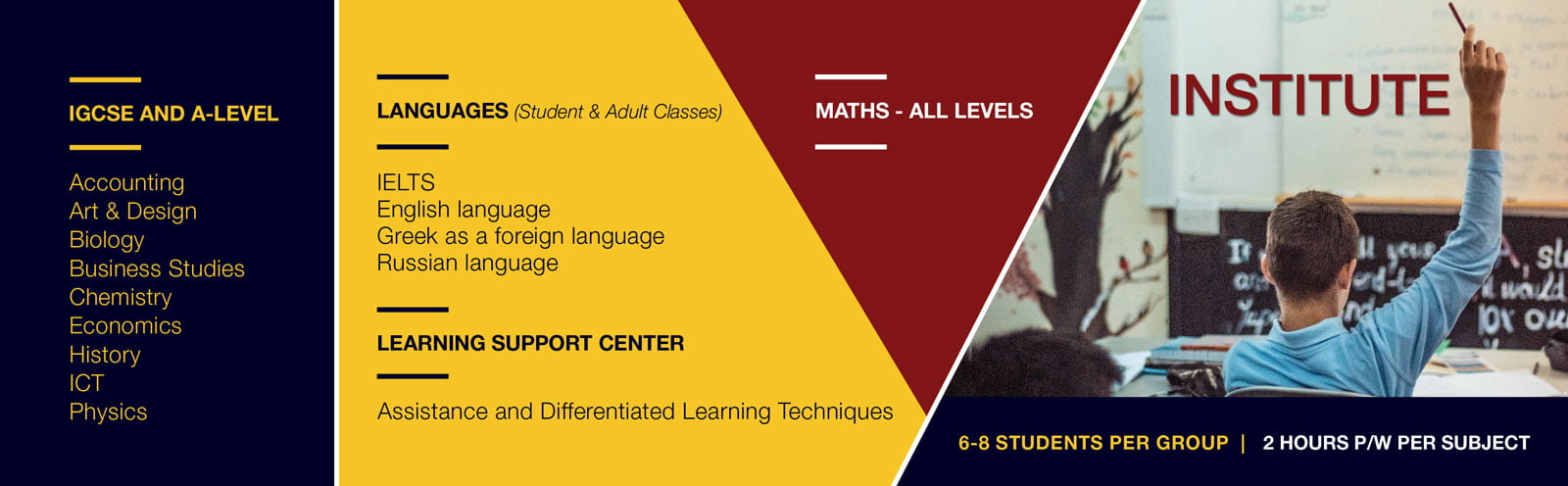
The Institute offers afternoon structured learning programs to students and adults of all levels.
 

General Information

The Private Institute of the American Academy in Limassol has been operating successfully as a Foreign Language Centre since 1986, offering high quality tuition to students of all age groups and all backgrounds.  The Institute’s high standards, the modern teaching methods, the small number of students in each class and the competence of our teaching staff justify the excellent examination results every year.
 
The Institute also offers special “Homework Classes” that cater to the needs of pupils who have difficulties doing their homework at home.  The children are taught how to study efficiently, productively and how to focus properly in order to enhance their concentration.  This eventually leads to autonomy where the children are able to overcome any potential difficulties in any subject when doing their schoolwork on their own at home.
 
Our teachers are university graduates, experienced and most of them are bi-lingual.  The environment is relaxed and friendly.  The management and parents are in continual contact which ensures cooperation from both sides.  The progress of each child is followed up and progress reports are prepared and given to parents every term.
 
Tutoring is between the hours of 2.00 pm to 7.00 pm and each lesson lasts an hour.  Students attend lessons at least twice a week.
Tuition fees are available on request.

Programme Description

Subjects taught at the Institute
  • All levels of English up to IGCSE
  • English for adults
  • Greek for adults
  • Modern Greek ‘IGCSE’ and ‘A’ level
  • Computers - All levels, ECDL and GCSE
  • Mathematics - All levels
  • Russian
  • Special Homework classes
  • Art
  • Physical Education – GCSE, GCE AS and A level
 

FAQs

  1. Which is the right age for a child to start learning English as a second language?
    Normally at the age of 7 depending on the maturity of the child and the family background.
  2. How many students in each class?
    Usually not exceeding the number of 8.
  3. Do you offer lessons one-to-one?
    Teacher-to-pupil lessons are endoresed as a more effective way of teaching as the instructor can focus on the weaknesses the student is facing. 
  4. How much are the fees?
    This depends on the subject and the level of teaching you would expect. I would encourage you to ring the head of Institute, Stella Siama to answer any questions regarding fees.
  5. Do you provide transport?
    Yes of course, at an extra cost.
  6. Do you offer evening lessons for working people?
    Yes, for language subjects are specially scheduled to fit in the busy routines for people that are busy during the day
Read more
Greek School

What is American Academy Private Greek School?

  • Our School has the same curriculum as public high schools and is approved by the Ministry of Education (Case HO 7.18.06.34 - 15/06/2004).
  • The main difference is that it is open all day and includes lunch.
  •  It provides students with the option of participating in the after school study and completion of homework and extra assistance is provided for all Pancyprian courses and examinations.
  • It gives children the right to participate in all national exams to secure position at the University of Cyprus and universities in Greece.
  • It is an invaluable opportunity for students who intend on enrolling in non-Greek-speaking international universities (UK) to prepare for and take International External Examinations (IGCSE and A 'LEVEL).

Our aims are to provide:

  • A High Level of Education
  • A Safe and Healthy Study Environment
  • Cultivation of Personality
  • Implementation of improved methods of teaching

Our school features:

  • Greek-orientation
  • European and international perspective
  • The school clock schedule and the Curriculum
  • Day School

Greek School timetable and schedule:

  • Faithful application of AP Ministry of Education of Cyprus
  • Increased periods of teaching in core subject such as Greek/Mathematics/English
  • Introduction of a Computer course
  • Help during the completion of homework
  • Small numbers of students by department
  • Support Programme
  • During the year students in the greek are encouraged to take GCSE and A'Levels

Day School Advantages

  • Attendance - supervision - guidance (away from harmful effects)
  • Individual Assistance
  • Scheduled Study
  • Many reference sources
  • Child safety 
  • Configuration data
  • Special tutorials - peace – economy
  • Lunch
  • Preparing students for exams in various subjects and Mathematics Olympic
Read more
English School

At the American Academy Primary School, we aim to provide quality education in a welcoming, stimulating environment regardless of gender, social or ethnic.  This has been achieved by building warm and trustworthy relationships with parents and children alike.

Our aims are to bring out the very best in each child with a strong commitment in nurturing positive attitudes, behaviour and respect.

Each child is unique and for this reason we educate them as an individual in order for them to develop and grow, giving them the academic knowledge and skills for them to reach to their full potential.

We build upon a child’s creativity, self esteem and strengths and work hard to improve any weaknesses.

Our ambition is to give children 'the roots to grow and the wings to fly.

The National Curriculum for England has been structured to provide students with an education that is recognised and which is held in high esteem around the world. It has been carefully planned to ensure progression in learning in all Key Stages.  Parents are informed of specific curriculum content for each academic term.

Read more
Early Years and Primary Summer School
 
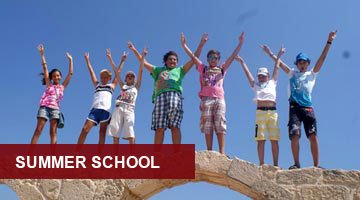
At the American Academy we have developed a Summer School Programme which appeals to all age groups, ensuring that all our participants have a fun-filled, action packed and adventurous summer.
We offer a variety of activities, including sports and arts and crafts, tailoring each session to suit the age and ability of the child.  The structure of each session allows children to enjoy the activity whilst placing them in a position where they can learn new skills.
 
English is improved in a fun and enjoyable way by using the computer, enjoying story time, playing games, as well as interactive whiteboard activities. 
 
You can view the 2012 summer school brochures from the links below


  Early Years Summer School Brochure 


                   Primary Summer School Brochure 


Summer School Program: 2 ½ to 5 year olds

Join us at the American Academy Early Years Summer School and meet the most extraordinary, funny and amazing British nanny in the world! Being a guest at Mary Poppins’s place is always fun. Throughout the summer we will go swimming, for excursions, have drawing lessons, story time and learn new words in English.
 
Mums can sit back and relax while their children enjoy their stay with us!
 
After all, they have visited Mary Poppins!
 
The American Academy Early Years Summer School runs for the whole month of July for all children aged between 2½ and 5. 

Summer School Program: 5, 6 and 7 year olds

Adventure crew is a team of pupils of ages 5, 6 and 7. Some of our activities are Adventure Playground, Aqua Slide, Art Explosion, Beach Ball, Bouncy Castle, Clay Modelling, Drama, Dodge Ball, Dance, Escape and Evasion, Face Painting, Food Fun, Football, Gymnastics, Imagination Session, Junior Orienteering, Making Music, Mini Olympics, Mini Tennis, Obstacle Challenge, Party and Parachute Games, Problem Solving, Quizzes, Story Time, Scavenger Hunt, Bowling, Swimming, Super Smoothies, Target Golf, Unihoc, Treasure Hunt and Water Mania!

Summer School Program:  8 - 10 year olds

Action crew is for older children. In addition to the above activities we have Danish Longball, Fame Game, Friendship Bracelets, Hair Braiding, Kite Making, Jewellery Making, Origami, Netball, Rounder’s, Orienteering, Pop Lacrosse, Softball and Ultimate!
 
American Academy Primary School offers Summer School Activities for children age 5 -11 years.
 
Read more

Upcoming Events

MAY
14

14.05.2012 - 18.05.2012
Work Placement: Class 4

MAY
18

18.05.2012
Last day of class teaching for class 4 & 5

Vinaora Nivo SliderVinaora Nivo SliderVinaora Nivo SliderVinaora Nivo SliderVinaora Nivo Slider